
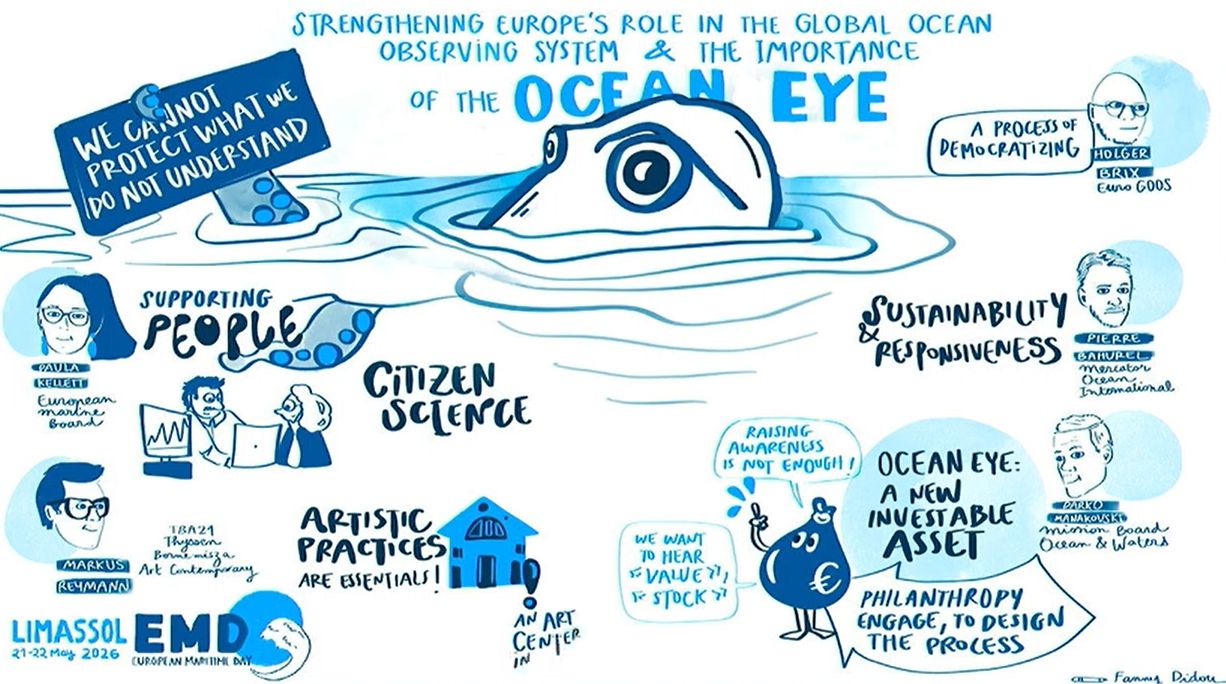
Europe is preparing the next step in its ocean observation ambitions with OceanEye, a new European initiative designed to strengthen Europe’s ocean monitoring, marine data systems, and digital ocean services.
Announced by European Commission President Ursula von der Leyen at the opening of the 2026 European Ocean Days in March, OceanEye is part of the wider European Ocean Pact. Launched in June 2025 ahead of the 3rd UN Ocean Conference, the Pact sets out a single political framework for EU ocean action, covering ocean health, a sustainable blue economy, coastal and island communities, ocean research and innovation, maritime security, and international ocean governance.
From the Ocean Pact to OceanEye
The European Ocean Pact recognises that effective ocean policy depends on trusted, accessible ocean knowledge. Across its priorities, the Pact points to the need for better information on the changing state of the ocean.
Ocean observations provide much of this information. Measurements from satellites, ships, autonomous platforms, buoys, and coastal monitoring networks help track ocean temperature, currents, sea level, marine life, pollution, and other changes over time. These observations feed marine data services, forecasts, and digital tools that support decision-making at sea and along the coast.
OceanEye is designed to strengthen this full chain, from observing the ocean to turning data into usable information. The initiative aims to reinforce Europe’s ocean observation capacity and connect it more closely with digital ocean systems, including marine data services and the European Digital Twin Ocean.
Connecting observations, data, and digital services
OceanEye sits within a wider international effort to consolidate the Global Ocean Observing System (GOOS) coordinated by UNESCO/IOC and to strengthen the systems that turn ocean data into usable knowledge. This includes the UN Decade of Ocean Science for Sustainable Development, which calls for a sustainably expanded Global Ocean Observing System and a digital representation of the ocean that can help users explore past, present, and future ocean conditions.
This observation-to-digital-services chain is also central to EU4OceanObs, which supports the EU’s engagement in international ocean observation and ocean data initiatives. Through the G7 Future of the Seas and Oceans Initiative, the EU supports international coordination on sustained ocean observations, data sharing, forecasting, and services. Through GEO Blue Planet, it helps connect ocean and coastal observations with the needs of users, including governments, communities, and organisations working on climate, ecosystems, and sustainable development.
OceanEye will provide a framework for developing and better connecting existing European ocean observation efforts (EOOS), including their interfaces with marine services such as EMODnet, Copernicus Marine Service, and the European Digital Twin Ocean.
The European Digital Twin Ocean is a virtual representation of the ocean that integrates data from satellites, sensors, computer models, and other sources to provide up-to-date information, forecasts, and “what if” scenarios. Developed through EDITO, the Digital Twin Ocean will be a public platform to support citizens, scientists, entrepreneurs, and policymakers make more informed decisions.
OceanEye at Digital Ocean Week
OceanEye will be a central focus of the first Digital Ocean Week, taking place in Brussels and online from 8–12 June 2026. Opening today on World Ocean Day, the week will bring together Member States, EU institutions, scientists, industry, and users to examine how Europe is building a more integrated Digital Ocean system for policy and operational use.
The week will feature the 9th Copernicus Marine General Assembly, which will review the many achievements of Copernicus Marine Service, a world leading EU marine service and the AI Ocean Forum, which will examine how artificial intelligence can support ocean observation, forecasting, services, and the European Digital Twin Ocean.
The high-level event “OceanEye: From Vision to Implementation” on 10 June will present the initiative and discuss its strategic priorities. These include an International Alliance, which will bring together EU Member States and international partners support the Global Ocean Observing System, in partnership with theIntergovernmental Oceanographic Commission, and secure access to open and free ocean data.